
Oracle APEX 18.1 introduces several game-changing features that strengthen APEX’s position as a cloud-ready development platform. In this post, I’ll focus on three features that I believe will help APEX win in the cloud.

1. REST Web Source Modules
This feature allows developers to access REST web service data through declarative APEX components without extensive custom coding. If you’ve ever struggled with consuming REST APIs in APEX, this feature is a game-changer.
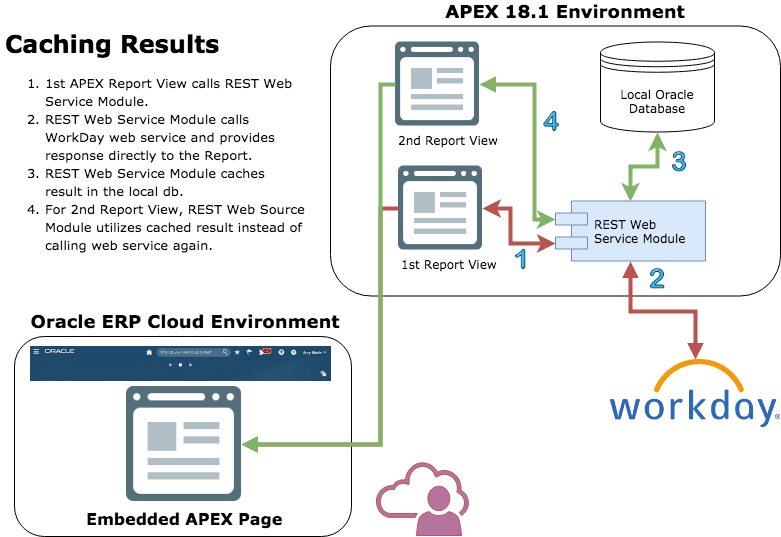
The wizard previews service responses and lets developers:
- Remove unwanted fields from the response
- Add calculated columns
- Configure data profile for APEX components
- Set up caching options (session, user, or all users)
- Apply post-processing SQL
APEX_EXEC Package
Beyond the declarative approach, the new APEX_EXEC PL/SQL package provides programmatic access to REST services. This opens up possibilities for batch processing and complex integrations.
Example Use Case
Consider displaying WorkDay employee data in an Oracle ERP Cloud page via an APEX embedded application. Previously, this would require:
- Custom PL/SQL to call the WorkDay API
- JSON parsing logic
- Error handling
- Session management
With REST Web Source Modules, you configure the connection once and use it across multiple pages declaratively.
2. REST Enabled SQL
This Oracle REST Data Services (ORDS) capability allows secure SQL execution on remote Oracle databases via REST. It’s like having a database link, but with modern REST-based security.
REST Enabled SQL supports:
- SELECT queries
- UPDATE, DELETE operations
- PL/SQL execution
- OAuth security controls
Example Use Case
Imagine an AP department using ERP Cloud that needs to view Purchase Order data from on-premise EBS. With REST Enabled SQL:
- Configure ORDS on the EBS database with OAuth security
- From APEX in ERP Cloud, query EBS data directly
- Users see integrated data without separate logins
This bridges the gap between cloud and on-premise systems without complex middleware.
3. Social Login

APEX 18.1 introduces a new authentication scheme supporting:
- Google authentication
- Facebook authentication
- OpenID Connect providers
- Any OAuth2 provider
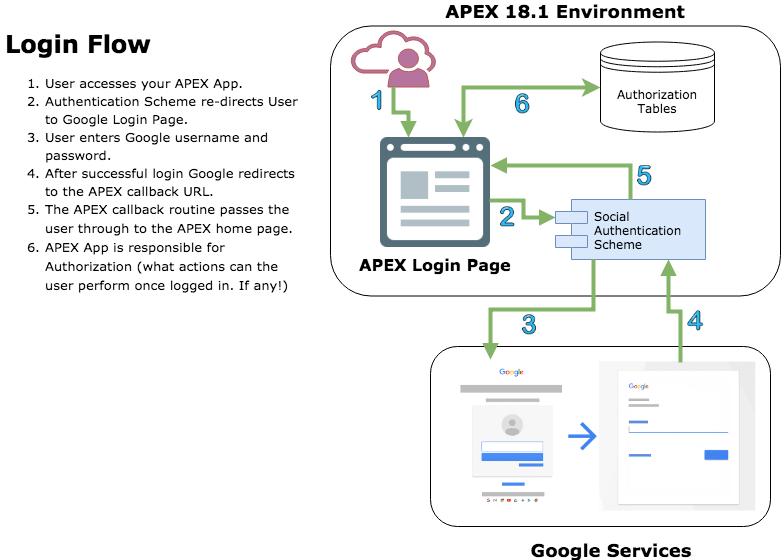
This eliminates the need for custom password management. Instead of storing and securing user credentials yourself, delegate authentication to trusted identity providers.
Benefits
- Security: Let the experts handle password storage and encryption
- User Experience: Users authenticate with credentials they already know
- Enterprise Ready: Support for corporate identity providers like Okta, Azure AD
- Reduced Development: No custom authentication code required
Conclusion
These three features - REST Web Source Modules, REST Enabled SQL, and Social Login - significantly enhance APEX’s cloud capabilities:
- Integration: Easily connect to any REST API
- Hybrid Architecture: Bridge cloud and on-premise systems
- Modern Authentication: Support enterprise and social identity providers
APEX 18.1 isn’t just keeping up with cloud trends; it’s providing practical solutions that make cloud development easier for Oracle developers.
Jon Dixon, Co-Founder JMJ Cloud